
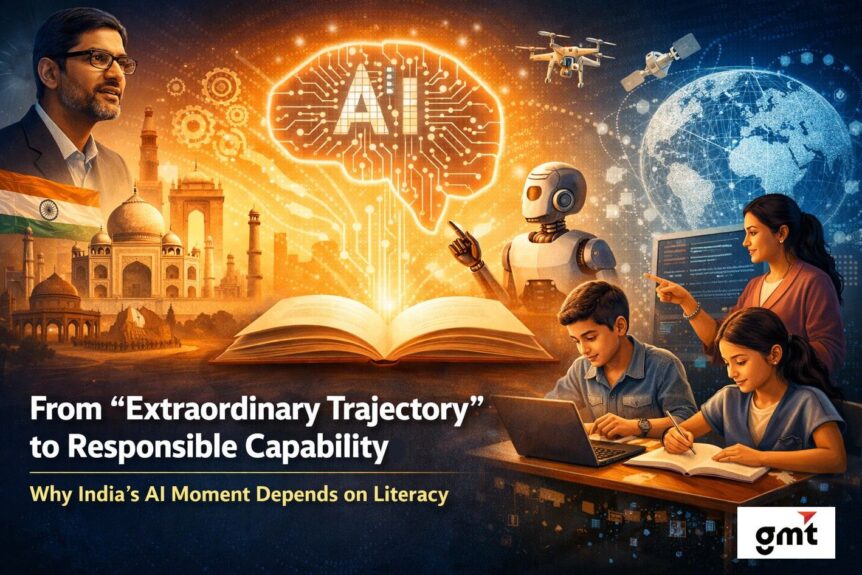
Why India’s AI Moment Depends on Literacy
When Sundar Pichai says, “India is going to have an extraordinary trajectory with AI,” he is pointing to
more than a technology wave. He is pointing to a structural shift: AI is becoming a new layer of capability
like electricity or the internet embedded into work, markets, and public systems. The question for India is
not whether AI will be present, but whether our institutions and families will shape how it is used.
Globally, AI is already reshaping industries through automation of routine cognitive tasks
(documentation, customer support, basic analysis) and augmentation of high-skill work (design
exploraton, code review, decision support). The economic implications are uneven: the IMF estimates that
about 40% of global employment is exposed to AI, with advanced economies seeing higher exposure and
a split between roles that are enhanced and roles that may be partially substituted. At the same time,
evidence remains mixed in the short run: an extensive executive survey reported limited measurable
impact on jobs or output so far, a reminder that adoption curves and productivity effects are rarely instant.
In governance, AI is being deployed for service delivery, fraud detection, and citizen interaction while
regulators attempt to catch up. The EU AI Act, for example, codifies a risk-based approach and sets
phased compliance timelines, signalling that “AI capability” is now a policy domain rather than just a
product feature. For India’s schools and households, this matters: the environment students grow into will
expect not only tool use, but judgment, accountability, and transparency.
For learners aged 10–18, the most profound change is cognitive. AI can become either cognitive
outsourcing (handing over thinking) or cognitive augmentation (amplifying thinking). The difference
shows up in everyday study habits:
● Structured prompting as a thinking skill: Good prompts are not “commands”; they are models of
reasoning, clear goals, constraints, assumptions, and evaluation criteria. Prompting well trains
precision, not just speed.
● AI-assisted research vs academic shortcutting: Used responsibly, AI can help students generate
questions, map arguments, identify gaps, and propose search terms. Used irresponsibly, it
becomes a shortcut that erodes comprehension, voice, and academic integrity.
● Metacognition in the AI age: Students must learn to ask, “Do I understand this, or do I merely
have an answer?” This self-monitoring becomes a core academic competency when answers are
abundant.
That leads to the central risk: not access to AI, but unguided access to AI. UNESCO has explicitly warned
that rapid GenAI rollout is outpacing educational readiness, raising concerns about privacy, tool
validation, and the need for age-appropriate guardrails.
This is where the distinction between AI access and AI literacy becomes decisive. Access means a student
can open a tool. Literacy means the student can question outputs, verify claims, protect privacy,
appropriately attribute assistance, and decide when not to use AI. Literacy is the difference between
producing a polished paragraph and building durable competence.
Parents play an underappreciated role in healthy adoption. What matters is not policing, but norm-setting:
clear family rules on when AI is allowed, requiring “show your work” (prompts, drafts, sources checked),
and protecting deep work, reading, problem-solving, and writing without automation.
A structured response is now essential. The AI Orientation Session, led by Ansh Mehra (Global AI
Educator impacting 800,000+ learners across 55+ countries), is designed to move families from
experimentation to informed practice, turning AI from a temptation into a disciplined learning partner. In
parallel, GMT AI is building structured AI literacy pathways for students that prioritize thinking quality,
ethical tool use, and academic integrity because the skill India needs is not “using AI,” but using AI
without losing the learner.
India’s AI trajectory will indeed be extraordinary, but only if we treat AI literacy as foundational, like
reading and numeracy. In the next decade, it won’t be an optional advantage; it will be the baseline for
credible work and trustworthy learning.
References
European Commission. (2024, August 1). AI Act enters into force. European Commission.
https://commission.europa.eu/news-and-media/news/ai-act-enters-force-2024-08-01_en
European Commission. (2026, January 27). AI Act. Shaping Europe’s digital future.
https://digital-strategy.ec.europa.eu/en/policies/regulatory-framework-ai
Georgieva, K. (2024, January 14). AI will transform the global economy. Let’s make sure it benefits
humanity. IMF Blog, International Monetary Fund.
https://www.imf.org/en/blogs/articles/2024/01/14/ai-will-transform-the-global-economy-lets-make-sure-
it-benefits-humanity
Holmes, W., & Miao, F. (2023). Guidance for generative AI in education and research. UNESCO.
https://unesdoc.unesco.org/ark:/48223/pf0000386693
TOI Tech Desk. (2026, February 21). CEO Sundar Pichai thanks Google India, shares photo with
Shubman Gill after AI Impact Summit: My favourite part…. The Times of India.
https://timesofindia.indiatimes.com/technology/tech-news/ceo-sundar-pichai-thanks-google-india-shares-
photo-with-shubman-gill-after-ai-impact-summit-my-favourite-part/articleshow/128641438.cms